Pumps & Tanks
Pumps, tanks and the controls that run them
If your well pump has stopped working, give us a call — our experienced staff will make the needed repairs as fast as possible.
Installation & repair
Designed as one system,
not four parts
Lincoln Pump can design your pump, tank, pipe and controls for maximum efficiency. A pump that fights an undersized tank, or a long run of pipe that was never sized for the flow, will cost you in power bills and in pump life — and it is the reason many systems fail early.
We sell and service the following types of pumps:
- Submersible
- Line Shaft
- Jet
- Booster
- Irrigation
- PTO Driven
We have also installed many pumps in lakes and creeks for irrigation and for fountains.
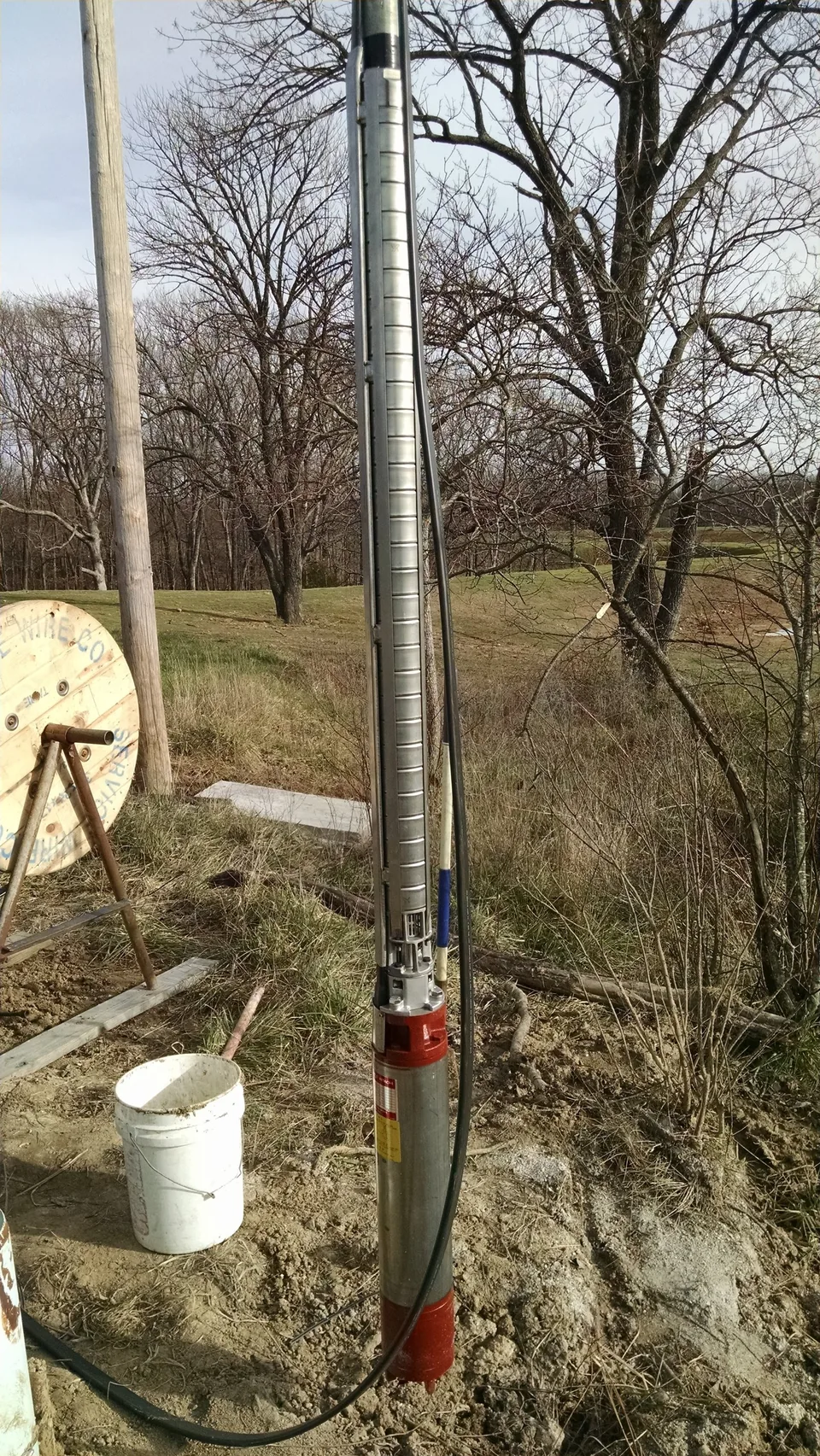
A submersible on the drop pipe, about to go down the hole.
Pump brands
A.Y. McDonald first, and the rest when they fit
Our preferred pump is A.Y. McDonald — roughly 95% of their pumps are made in the USA, which matters to us and to the people who have to live with the repair bill. We carry the other national names as well.
- A.Y. McDonald
- Grundfos
- Franklin
- Webtrol
- Berkeley
- Sta-Rite
- Schaefer
- Pentair
- Lo-Lift
- Stenner
- Goulds
- Meyers
Pressure tanks
From one gallon to five thousand
The tank is what keeps the pump from starting every time someone runs a faucet. Size it right and the pump lasts; size it wrong and you replace the pump early.
Steel tanks
- Challenger
- Well-Rite
- FlexCon
- Well-X-Trol
Fiberglass tanks
- Flex-Lite
- Well Mate
1–120 gallons
The range those tanks cover, which handles the great majority of homes and small systems.
Mid-size systems
More than one tank can be installed in series when a single tank will not carry the demand.
500–5,000+ gallons
On larger systems we use steel tanks painted on the outside and epoxy coated on the inside.
Whether you need a one gallon tank or one over three thousand, we can design and install it for you.
Before it quits
Signs your pump is in trouble
- A breaker trips twice.
- More than one fuse blows.
- The water pressure is surging.
- The lights dim when the pump turns on.
- The pump starts and stops more than usual.
- The water pressure is low.
- Water is discolored, muddy or cloudy.
- The overload trips more than twice.